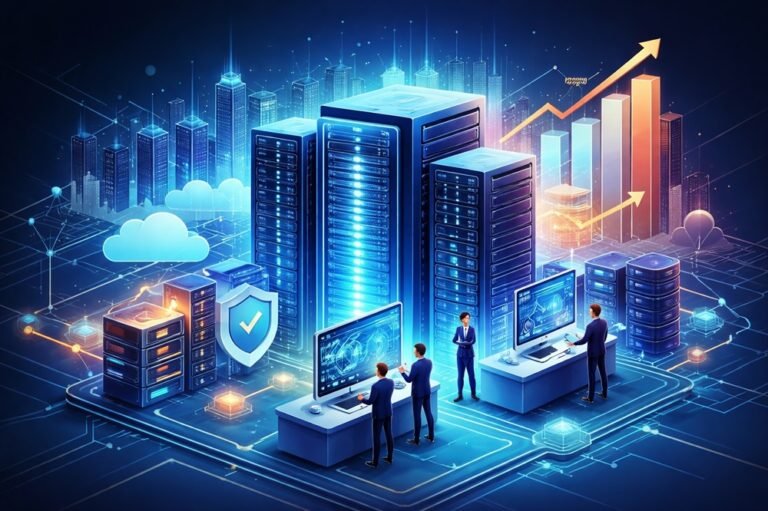

In today’s digital-first world, data centers are the backbone of business operations, supporting everything from cloud computing to enterprise applications. Choosing the right data center solution is a strategic decision that directly impacts performance, security, scalability, and business continuity. Below is a detailed exploration of the most critical features to consider when evaluating an effective data center solution.
1. High Availability and Uptime Guarantees
One of the most important features of a data center is uptime reliability. Downtime can lead to financial losses, reputational damage, and operational disruption.
- Industry-leading data centers typically offer uptime guarantees of 99.99% or higher
- The Tier classification system defines reliability levels:
- Tier I: ~99.67% uptime (basic)
- Tier II: ~99.74% uptime (partial redundancy)
- Tier III: ~99.982% uptime (high availability)
- Tier IV: ~99.995% uptime (fault-tolerant)
Higher-tier facilities provide better resilience and are ideal for mission-critical operations.
2. Redundancy and Fault Tolerance
Redundancy ensures that if one component fails, another takes over instantly, preventing service disruption.
Key redundancy elements include:
- Dual power supplies and backup generators
- Multiple cooling systems (N+1 or 2N redundancy)
- Multiple network paths and carriers
Redundant architecture eliminates single points of failure and is essential for maintaining continuous operations .
3. Robust Power Infrastructure
Power reliability is fundamental to data center performance. An effective solution should include:
- Uninterruptible Power Supply (UPS) systems
- Backup generators with fuel reserves
- Dual power feeds
Even a short power interruption can disrupt services, so a strong power infrastructure is critical to maintaining uptime and protecting equipment .
4. Advanced Cooling and Environmental Control
Efficient cooling systems are necessary to prevent overheating and maintain optimal performance.
Important features include:
- Precision HVAC systems
- Hot/cold aisle containment
- Airflow management strategies
Proper cooling not only extends hardware lifespan but also improves energy efficiency and reduces operational costs.
5. Physical and Cyber Security
Security is a top priority for any data center.
Physical Security:
- Biometric access controls
- 24/7 surveillance (CCTV)
- Security personnel and restricted zones
Cybersecurity:
- Firewalls and intrusion detection systems
- DDoS protection
- Encryption and secure access protocols
A secure data center protects sensitive business data from both physical and digital threats.
6. Scalability and Flexibility
As businesses grow, their data center requirements evolve. A modern data center solution must support:
- Easy expansion of storage and compute resources
- Modular infrastructure design
- Support for hybrid and multi-cloud environments
Scalability ensures that the infrastructure can handle future demands without major redesign or downtime .
7. Network Connectivity and Performance
High-speed, reliable connectivity is essential for seamless operations.
Key considerations:
- Multiple network carriers (carrier-neutral facilities)
- Low-latency connections
- High bandwidth capacity
Redundant network paths ensure uninterrupted connectivity even if one provider fails.
8. Disaster Recovery and Backup Capabilities
A strong disaster recovery (DR) strategy is critical for business continuity.
Features to look for:
- Offsite data backups
- Automated failover systems
- Disaster recovery planning and testing
DR solutions enable rapid recovery from events such as natural disasters, cyberattacks, or hardware failures .
9. Location and Risk Management
The physical location of a data center plays a crucial role in its reliability.
Considerations include:
- Low risk of natural disasters (floods, earthquakes)
- Proximity to business operations
- Accessibility for maintenance
A well-chosen location minimizes environmental risks and ensures operational stability .
10. Monitoring and Management (DCIM)
Modern data centers use Data Center Infrastructure Management (DCIM) tools to monitor and optimize operations.
Capabilities include:
- Real-time monitoring of power, cooling, and network
- Predictive maintenance
- Performance analytics
These tools improve efficiency, reduce downtime, and provide better control over infrastructure.
11. Compliance and Certifications
Compliance ensures that the data center meets industry standards and regulatory requirements.
Common certifications:
- ISO 27001 (information security)
- SOC 2 (service organization controls)
- PCI DSS (payment data security)
Compliance is especially important for industries like finance, healthcare, and e-commerce.
12. Expert Support and Service Level Agreements (SLAs)
Reliable support services are essential for smooth operations.
Look for:
- 24/7 technical support
- Defined SLAs with uptime guarantees
- Rapid response times
Strong SLAs ensure accountability and provide assurance of service quality.
Conclusion
An effective data center solution is defined by a combination of reliability, security, scalability, and performance. Key features such as high uptime, redundancy, robust power and cooling systems, strong security, and disaster recovery capabilities are essential for supporting modern digital operations.
Organizations should carefully evaluate these factors based on their business needs. For most enterprises, Tier III or Tier IV data centers provide the optimal balance between cost and performance, ensuring high availability and long-term scalability.