As urban environments expand and vehicle ownership continues to rise, parking has become one of the most persistent challenges in modern infrastructure. From commercial buildings and residential complexes to airports and smart cities, inefficient parking systems lead to congestion, wasted time, and frustrated users. Smart parking solutions are transforming this landscape by introducing automation, real-time data, and intelligent management.
What Are Smart Parking Solutions?
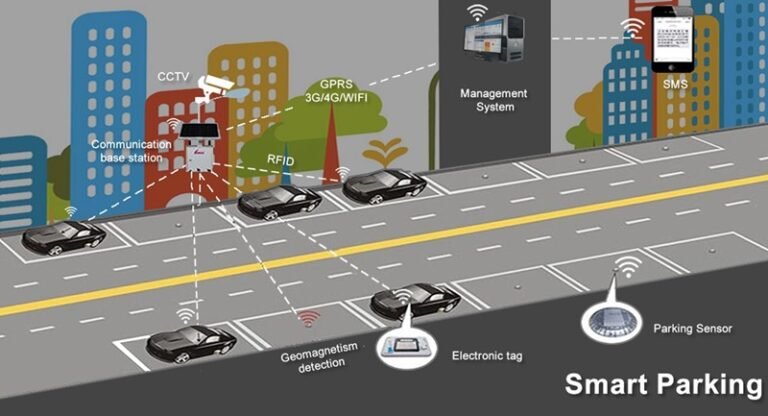
Smart parking solutions are technology-driven systems designed to optimize the use, management, and accessibility of parking spaces. These systems rely on sensors, cameras, cloud platforms, and mobile applications to provide real-time information about parking availability and usage.
Instead of manually searching for a parking spot, drivers can instantly locate available spaces, reserve them, and even make digital payments. At the same time, operators gain full visibility and control over parking operations.
Why Modern Infrastructure Needs Smart Parking
Traditional parking systems are no longer sufficient for today’s high-density environments. Studies show that drivers can spend up to 20 minutes searching for parking in urban areas, contributing to traffic congestion and fuel waste.
Modern infrastructure demands smarter, data-driven solutions that can:
- Handle increasing vehicle volumes
- Reduce traffic congestion
- Improve user experience
- Optimize space utilization
- Support sustainability goals
Smart parking is not just a convenience anymore, it’s a necessity for efficient urban mobility.
Key Components of Smart Parking Systems
1. Smart Sensors and Detection
Sensors (magnetic, ultrasonic, or camera-based) detect whether a parking space is occupied or vacant. These sensors continuously send data to a central system.
2. Real-Time Data & Cloud Integration
Data from sensors is processed in real time and stored in cloud platforms, enabling instant updates on parking availability.
3. Parking Guidance Systems
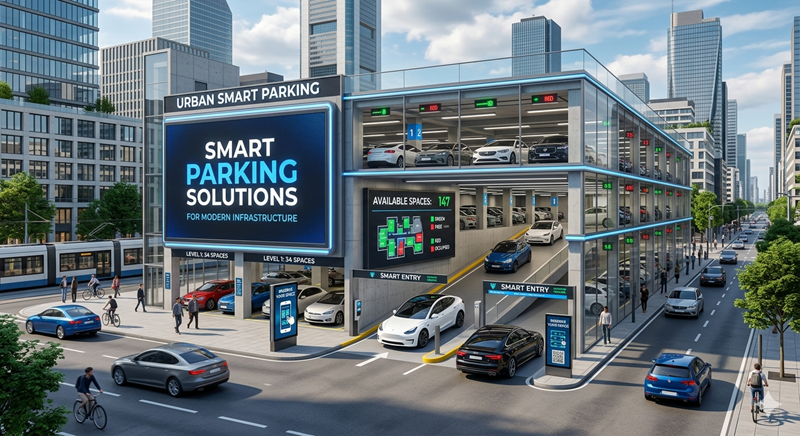
Digital signage and mobile apps guide drivers directly to available parking spots, eliminating guesswork and reducing search time.
4. License Plate Recognition (LPR)
Automated vehicle identification enables seamless entry, exit, and security monitoring.
5. Smart Payment Systems
Cashless payments through apps, QR codes, or automated billing simplify transactions and reduce manual effort.
Benefits of Smart Parking Solutions
1. Reduced Traffic Congestion
By guiding drivers directly to available spots, smart parking minimizes unnecessary driving and traffic buildup.
2. Time and Cost Efficiency
Drivers save time and fuel, while operators reduce operational costs through automation.
3. Improved User Experience
Real-time updates, easy navigation, and digital payments create a seamless parking experience.
4. Better Space Utilization
Smart systems maximize the use of available parking spaces, reducing wastage and increasing efficiency.
5. Enhanced Security
With integrated surveillance and vehicle tracking, parking areas become safer and more controlled.
6. Environmental Sustainability
Less time spent searching for parking means reduced fuel consumption and lower carbon emissions.
Applications Across Modern Infrastructure
Smart parking solutions are highly adaptable and can be deployed across various sectors:
- Commercial Buildings & Offices – Streamlined employee and visitor parking
- Shopping Malls & Retail Centers – Improved customer convenience
- Hospitals – Faster access for patients and emergency vehicles
- Airports – Efficient large-scale parking management
- Residential Complexes – Secure and organized parking systems
- Smart Cities – Integrated urban mobility solutions
These systems support both small-scale facilities and large, high-density environments.
The Role of AI and IoT in Smart Parking
Modern smart parking systems are increasingly powered by Artificial Intelligence (AI) and the Internet of Things (IoT). These technologies enable:
- Predictive parking availability
- Automated traffic flow management
- Data-driven decision-making
- Integration with broader smart city ecosystems
AI-based video analytics, for example, can detect vehicles and monitor parking usage with high accuracy, further improving system performance.
Challenges and Considerations
While smart parking offers significant advantages, implementation requires careful planning:
- Initial investment costs
- Integration with existing infrastructure
- Data privacy and security
- Maintenance of sensors and systems
However, the long-term benefits often outweigh these challenges, especially in rapidly growing urban environments.
The Future of Smart Parking
Smart parking is evolving rapidly as part of the broader smart city movement. Future developments may include:
- Fully automated parking systems
- Integration with autonomous vehicles
- Advanced predictive analytics
- Seamless multi-modal transportation systems
As cities continue to grow, smart parking will play a critical role in shaping efficient, sustainable, and user-friendly infrastructure.
Conclusion
Smart parking solutions are redefining how modern infrastructure manages mobility. By combining real-time data, automation, and intelligent systems, they address long-standing parking challenges while enhancing efficiency, convenience, and sustainability.
For businesses, property developers, and city planners, investing in smart parking is no longer optional. It’s a strategic move toward smarter, more connected, and future-ready infrastructure.