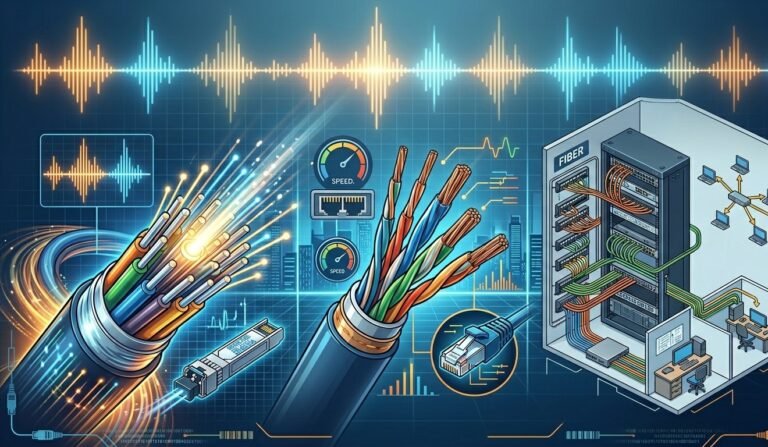

In today’s hyper-connected digital landscape, businesses demand high-speed, low-latency, and reliable network performance to support cloud computing, remote work, IoT devices, and real-time applications. Traditional network infrastructures, built for a different era, often struggle to meet these demands. This has led to the emergence of modern infrastructure solutions designed to deliver faster, smarter, and more scalable networks.
This article explores the key technologies, architectures, and strategies that power modern high-speed networks.
1. The Need for Modern Network Infrastructure
Legacy network systems were primarily designed around centralized data centers and predictable traffic flows. However, modern enterprises now rely on:
- Cloud applications (SaaS, IaaS)
- Remote and hybrid workforces
- Real-time communication (video, VoIP)
- IoT and edge devices
Traditional WAN architectures often route traffic through centralized data centers, causing latency and bottlenecks.
Modern infrastructure eliminates these inefficiencies by introducing distributed, software-defined, and cloud-native approaches.
2. Software-Defined Networking (SDN)
One of the most transformative innovations is Software-Defined Networking (SDN).
Key Concept:
SDN separates the control plane (decision-making) from the data plane (traffic forwarding), enabling centralized network management.
Benefits:
- Centralized control and automation
- Faster configuration and deployment
- Improved scalability and flexibility
- Real-time network optimization
SDN is especially critical in data centers, where dynamic workloads require rapid adjustments in network configuration.
3. SD-WAN: The Backbone of Modern Connectivity
What is SD-WAN?
Software-Defined Wide Area Network (SD-WAN) is a modern approach to WAN connectivity that uses software to intelligently route traffic across multiple network links.
It creates a virtual overlay across different transport technologies such as:
- MPLS
- Broadband internet
- Fiber
- 4G/5G networks
Why SD-WAN is Essential
- Direct cloud access (no backhauling delays)
- Centralized policy management
- Cost-effective compared to traditional MPLS
- Improved application performance
SD-WAN enables businesses to connect branch offices, data centers, and cloud platforms efficiently, eliminating bottlenecks and improving user experience.
4. Cloud-Native Networking
Modern infrastructure is increasingly built around cloud-first architectures.
Key Features:
- Elastic scalability
- Global accessibility
- High availability
- Pay-as-you-go models
Cloud networking allows organizations to deploy services closer to users, reducing latency and improving speed.
Hybrid & Multi-Cloud
Businesses are adopting:
- Hybrid cloud (on-prem + cloud)
- Multi-cloud (multiple providers)
This ensures redundancy, flexibility, and optimized performance.
5. Edge Computing for Low Latency
Edge computing brings data processing closer to the source (users/devices) rather than relying solely on centralized data centers.
Advantages:
- Reduced latency
- Faster response times
- Lower bandwidth usage
- Real-time analytics
This is critical for:
- IoT applications
- Autonomous systems
- Smart cities
- Industrial automation
6. 5G and Network Slicing
The rollout of 5G networks is revolutionizing infrastructure capabilities.
Key Benefits:
- Ultra-low latency
- High bandwidth
- Massive device connectivity
A major innovation is network slicing, which allows multiple virtual networks to run on a single physical infrastructure, each optimized for specific use cases.
For example:
- One slice for healthcare applications
- Another for IoT devices
- Another for enterprise operations
7. Secure Access Service Edge (SASE)
Security is a critical component of modern networks.
What is SASE?
SASE combines:
- SD-WAN
- Cloud security services
into a unified framework.
Benefits:
- Integrated security and networking
- Zero Trust architecture
- Secure remote access
- Simplified management
SASE ensures that faster networks are also secure and compliant.
8. Automation and AI-Driven Networking
Modern networks are becoming intelligent and self-optimizing.
Key Capabilities:
- AI-based traffic routing
- Predictive maintenance
- Automated fault detection
- Performance analytics
AI helps networks adapt in real time, improving efficiency and minimizing downtime.
9. High-Speed Data Center Infrastructure
Modern data centers are evolving to support faster networks through:
- High-density fiber cabling
- Leaf-spine architectures
- Low-latency switching
- Hyperconverged infrastructure (HCI)
These technologies ensure rapid data transfer and scalability for cloud and enterprise workloads.
10. Benefits of Modern Infrastructure Solutions
Organizations adopting modern network infrastructure experience:
🚀 Faster Performance
- Reduced latency
- Optimized traffic routing
📈 Scalability
- Easily adapt to growing business needs
💰 Cost Efficiency
- Reduced reliance on expensive legacy systems
🔒 Enhanced Security
- Integrated security frameworks
🌐 Better User Experience
- Seamless access to applications and services
Conclusion
Modern infrastructure solutions are no longer optional—they are essential for businesses aiming to stay competitive in a digital-first world. Technologies like SD-WAN, SDN, cloud networking, edge computing, and 5G are transforming how networks are built and managed.
By embracing these innovations, organizations can achieve faster, more reliable, and secure networks, enabling them to support future growth, innovation, and digital transformation.